Tenofovir and emtricitabine: how Tenvir-EM differs from original Truvada

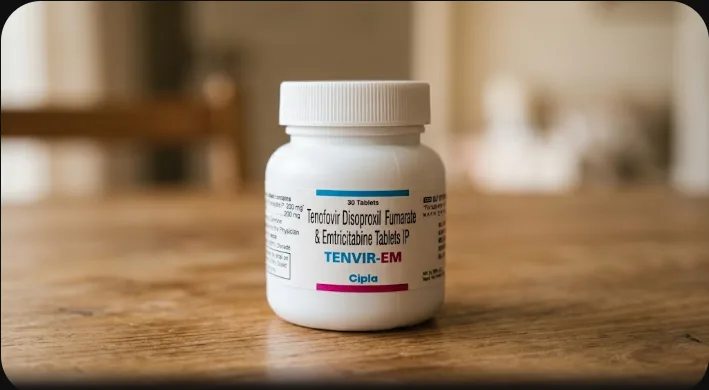
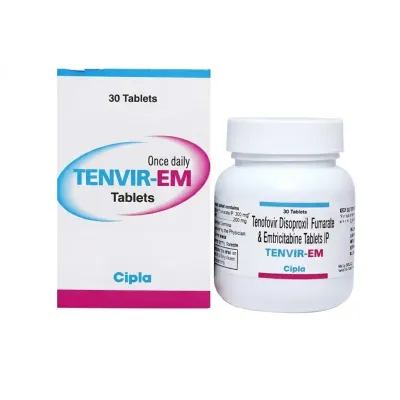
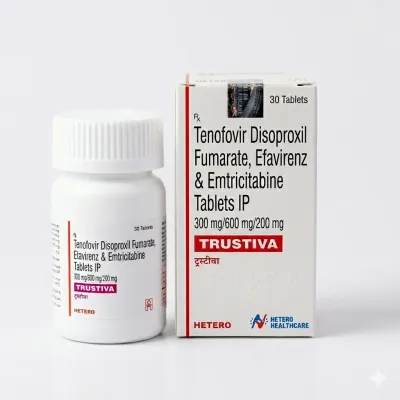
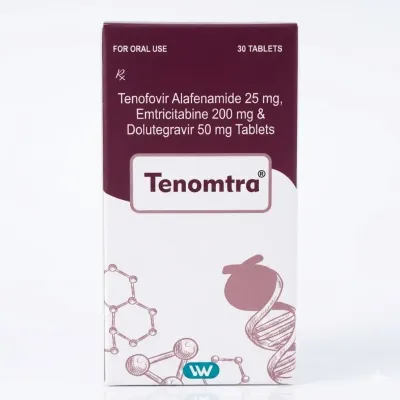
The tenofovir + emtricitabine combination has two jobs. The first is treating HIV: many treatment regimens are built on it. The second is prevention: since 2012 the same tablet has been prescribed to HIV-negative people at high risk of infection. This is called PrEP, pre-exposure prophylaxis. The original drug is Truvada by Gilead Sciences. In the Unifarm catalogue the same composition is sold as Tenvir-EM, and in triple regimens as Viraday, Trustiva and Tenomtra.
One thing up front: both treatment and PrEP are prescribed and monitored by an infectious disease doctor after tests. This article helps you understand the picture, not choose a regimen yourself.
One combination, two different uses
HIV keeps its genes in RNA. To insert itself into a human cell, the virus first has to rewrite them into DNA, and it has its own enzyme for that: reverse transcriptase. Tenofovir and emtricitabine pose as ordinary DNA building blocks. The enzyme picks them up, and at that point the chain breaks off: there is nothing left to copy. Drugs like these are called reverse transcriptase inhibitors (NRTIs).
HIV adapts quickly to any single drug. That is why treatment always uses at least three active substances at once, from different classes. Tenofovir with emtricitabine is the base, and a third component is added to it.
How triple regimens are put together

Tenofovir + emtricitabine
the base of treatment, or on its own for PrEP

+ efavirenz
three substances in one tablet, once a day; a generic of Atripla

+ efavirenz
the same composition as Viraday, a different manufacturer
Efavirenz in Viraday and Trustiva belongs to another class (NNRTIs). It blocks the same viral enzyme but attaches to it at a different spot. When one target is hit from two sides, it is much harder for the virus to mutate its way out of treatment. In newer regimens the third component is an integrase inhibitor. Tenomtra, with dolutegravir, is built that way.
For PrEP: the same tablet, a different logic
PrEP is taken by people without HIV so that they do not get infected. Usually it is one tablet every day, prescribed by a doctor, with an HIV test about every 3 months. A third component is not needed here: the task is not to suppress a virus that is already multiplying, but to stop it from taking hold in the body after exposure.
Two things people often forget: PrEP does not protect against other sexually transmitted infections, and it does not replace condoms.
Generic and original
| Parameter | Truvada (original) | Tenvir-EM (generic) |
|---|---|---|
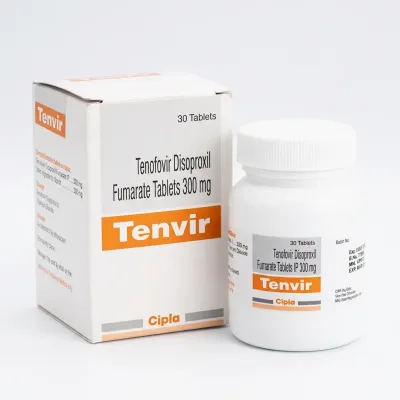
| Active ingredients | Tenofovir disoproxil 300 mg + emtricitabine 200 mg | Tenofovir disoproxil 300 mg + emtricitabine 200 mg |
| Manufacturer | Gilead Sciences (USA) | Cipla (India) |
| Dosing | 1 tablet a day | 1 tablet a day |
| Price | Higher | Lower |
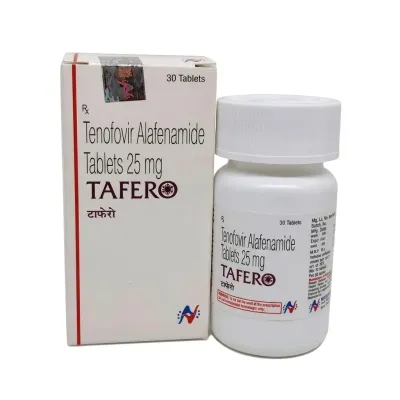
Tenofovir also comes in a newer form, alafenamide (TAF). With the same effectiveness it puts less strain on the kidneys and bones. In the catalogue this is Tafero (used in hepatitis B), and in HIV treatment TAF is part of Tenomtra. Which form suits you is for the doctor to decide from your kidney function and other circumstances.
What not to forget
- An HIV test is mandatory before PrEP. If the infection is already there but unknown, two drugs instead of three are not enough: the virus has time to develop resistance.
- Kidneys are checked before starting and regularly afterwards. Tenofovir disoproxil is cleared through the kidneys and can affect them with long-term use, especially alongside other drugs that are hard on the kidneys.
- Missed doses are the main enemy. In both treatment and PrEP, protection depends on regularity. Missed tablets are the most common reason therapy stops working.
- Efavirenz can disturb sleep in the first weeks. Vivid dreams and insomnia on Viraday or Trustiva usually pass on their own. It is better to know in advance so that you do not give up treatment.
- These are prescription drugs. Neither treatment nor PrEP is chosen from advice on the internet. The decision is made by an infectious disease doctor after tests.